What if tomorrow's IT professional were a Swiss Army knife?

As artificial intelligence reshapes the IT job market, does specialising still give you an edge? What if the future of our profession belonged to generalists who can connect business, technology and AI? A reflection on how our work is changing and what that could mean for vocational training in Switzerland.
A changing job market
I’ve been thinking for a while about what AI means for the future of our profession, and I think I’m starting to see a particular kind of IT professional emerge. I wanted to share a few thoughts on that with you.
I spent several years in the IT industry, mainly in systems engineering and DevOps, before I became an IT teacher. That gives me two ways to look at this change. I can see what it means for companies and what it means for the people we’re training to work in them.
Since generative AI arrived, the IT job market in Switzerland has worsened.
Using figures from the State Secretariat for Economic Affairs (SECO), ICTjournal reports that registered unemployment in IT and ICT occupations rose from 3.68% to 3.80% between January and June 2026. In the Lake Geneva region, it reached 6.54%. ICTjournal, 14 July 2026
The figures for recent graduates are more worrying. Among graduates with a bachelor’s degree in technical or IT fields from a university of applied sciences, the unemployment rate one year after graduation rose from 3% to 6.4% between the 2023 and 2025 surveys. This rate uses the International Labour Organization (ILO) definition. ICTjournal, 1 September 2026
Among 2024 graduates with a bachelor’s degree in technical or IT fields from a university of applied sciences who had difficulty finding a job that matched their aspirations, more than 85% cited a lack of work experience. Swiss Federal Statistical Office data
The data on graduates from universities of applied sciences doesn’t directly cover people with a Swiss Federal VET Diploma (CFC). The unemployment figures on their own can’t establish a causal link with AI. But the trend is worrying enough to make us ask what the job market will look like for young people starting out.
I’ve also talked to several former colleagues and friends who work in infrastructure and software development.
I keep hearing much the same things.
- More layoffs and restructurings.
- More difficulty finding another job.
- Far fewer headhunters in their LinkedIn DMs, if any at all.
- Smaller technical teams.
There’s one development that especially caught my attention.
At several companies, I’ve seen development teams shrink and split into smaller groups. While developers are being laid off, new product owners are being hired to join those same teams.
Some technical roles are disappearing, while roles that connect the business side with the technical side are being created.
I think that shift deserves a closer look.
What kind of IT professional will bring companies the most value?
Companies want to get more for their money. That’s nothing new.
They want to get more done, cut costs, deliver projects faster and get as much value as they can from the work.
AI is changing how they can do that.
Take a hypothetical project to build an internal application.
A few years ago, a company might have needed several people with different skills.
- A business analyst to understand what the business needs.
- A product owner to define and prioritise features.
- A frontend developer.
- A backend developer.
- A systems or DevOps engineer to manage the infrastructure.
- A testing and quality assurance specialist.
Today, AI agents can assist with parts of the work these people do.
Now imagine an IT professional who can talk directly with people in the business, understand what they need, design a solution and coordinate different AI agents to carry out much of that work.
This person can work across frontend, backend, infrastructure and project management without necessarily having deep expertise in any one of them.
They know enough about each area to understand what they’re doing, make decisions and oversee the work their AI agents produce.
If one person can deliver comparable value to several team members on certain projects, the economics start to look quite different.
That’s the kind of IT professional I’m starting to see emerge.
The Swiss Army knife of IT
I’ve always liked the expression Jack of all trades, master of none.
Someone who can do a bit of everything, without necessarily being a specialist in any one thing.
For a long time, the expression had a somewhat negative connotation in some workplaces. We tended to place more value on people who specialised and became experts in one area.
What if AI changes that?
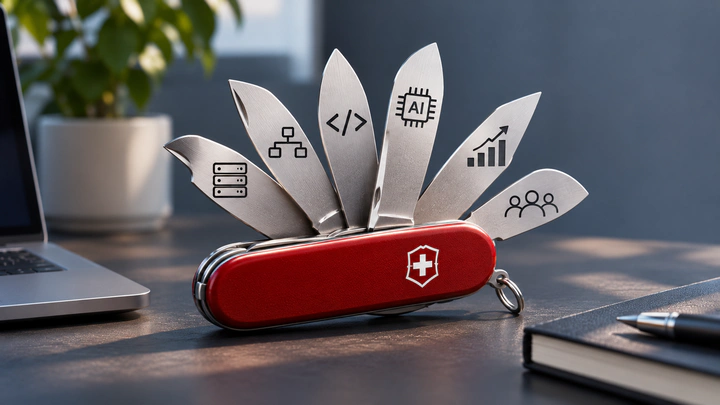
I picture tomorrow’s IT professional as a Swiss Army knife.
Someone who can speak the language of business and the language of technology. Someone with a good grounding in software development, infrastructure, networking, cybersecurity and project management.
They know enough about each of those areas to make them work together, even without specialist expertise in any one of them.
Above all, they can use AI to go beyond what they could do on their own.
A dedicated screwdriver, knife or pair of scissors may do its own job better.
The strength of a Swiss Army knife is that a single tool can adapt to a lot of different jobs.
I think that describes what part of our profession could become.
AI would add to what this Swiss Army knife can do by making much more advanced technical capabilities available when needed.
The different blades of the Swiss Army knife
I’d build this role around five groups of skills.
Technical skills. Understand systems, networks, software development, databases, cloud and cybersecurity.
Business skills. Understand what a company needs, how it works, what it’s trying to achieve, what it can afford and what value it expects from a solution.
AI skills. Use, coordinate and supervise AI agents, automate processes and check the quality of the results.
People skills. Communicate, listen, negotiate, explain technical concepts in plain language and work with a range of people.
Critical thinking. Question a proposed solution, recognise its limits, assess its risks and take responsibility for decisions.
What would make this person effective is being able to draw on all five areas to solve a problem, whatever their depth of expertise in each.
Is it time to rethink specialisation?
This is probably the most controversial part of what I’m arguing.
For years, we’ve encouraged IT professionals to specialise.
You become a frontend developer, a backend developer, a network engineer, a systems engineer, a cloud engineer, a cybersecurity specialist, a database administrator, and so on.
Then each of those areas breaks down into further specialisations.
That made a lot of sense when you could only draw on what you knew and whatever time you had to learn something new.
AI changes that equation.
Take a systems engineer with a good grounding in software development who’s never built a mobile app.
A few years ago, building a complete mobile app would have meant spending a lot of time learning new skills or hiring a specialist developer.
Today, with AI, that same engineer could potentially design and build a working app while learning the technologies they need as they go.
I’ve seen this in my own IT projects.
AI lets me work in areas that I probably wouldn’t have ventured into on my own a few years ago.
Expertise still takes time to build.
You still have to understand the solutions you produce and check their quality, security and maintainability.
I think specialists will always have a place. We’ll still need people with deep expertise to solve especially complex problems.
I do wonder whether every company will still need as many full-time specialists, though.
Generalists working with AI could take on some of their work and call in an expert when a problem gets complex enough to need one.
That’s where the Swiss Army knife differs slightly from the T-shaped engineer.
A T-shaped engineer typically has deep expertise in one area and a working knowledge of several others.
The kind of generalist I have in mind relies even more on working across disciplines. Their real speciality could be understanding the problem, connecting different fields and bringing together the resources needed to solve it.
In a way, their speciality would be their versatility.
Why I see myself in this role
One reason this prospect excites me is that I’ve always seen myself in this kind of role.
I’ve always thought of myself as a jack of all trades, master of none, a sort of IT Swiss Army knife.
Over the course of my career, I’ve picked up skills in a lot of different areas. My work gave me a solid background in infrastructure, systems engineering and DevOps. Over the years, my personal projects helped me build on that with skills in software development, app development and, more recently, AI.
I also earned a Swiss Federal Diploma of Higher Education in Business Informatics, which helped me round out my technical skills with management, project management and a better understanding of how businesses work and what matters to them.
I’ve never really tried to stick to one area of IT. I’ve always enjoyed exploring new technologies, finding out how different disciplines fit together and broadening what I can do.
That versatility is also what I try to bring to my freelance work through AlexIn Tech.
It means I can understand what a client needs, suggest a solution, build an application, set up the infrastructure it runs on, automate processes or help the client bring AI into their work.
What I find particularly interesting about AI is how much more I can do with that range of skills. It lets me go further in each area, take on more ambitious projects and draw on all my skills in a single project.
Being seen as someone without a narrow specialisation might once have counted against me. In the future, it could be a real strength.
That’s another reason this prospect excites me. The kind of IT professional I see emerging looks a lot like the one I’ve become over the course of my career, without necessarily seeing this shift coming.
Beyond my own career, though, it’s as a teacher that I find this prospect most exciting.
I see a lot of potential in people who can combine technical, business and people skills and use AI to extend what they can do.
I’m convinced we can train young people who’ll bring a great deal of value to companies precisely because they can work across these areas.
And I think we should gradually steer our training programmes in that direction.
As technical work gets easier, understanding the business matters more
I think one of the skills that’ll become most valuable in the next few years is the ability to understand what people need and turn that into technical solutions.
AI can generate code, suggest an architecture or automate a process.
We still have to figure out which problem we’re trying to solve.
At a company, requirements are rarely perfectly clear. Users don’t always know exactly what they want. Departments can have competing priorities. Budgets, how teams are organised and the people available to do the work keep changing.
You need to be able to ask the right questions.
- Why do we need this feature?
- What problem are we actually trying to solve?
- What value does it bring to the company?
- Is there a simpler solution?
- Are we dealing with a technical problem or an organisational one?
That’s one reason I find the shift I mentioned at the start of the article interesting. Product owners are playing a bigger role at some companies.
Companies still seem to need people who can understand others, clarify what they need and make decisions.
I think IT professionals who can take on some of that work alongside their technical responsibilities could have a considerable advantage.
Developers can do some of that work while keeping their own role.
Over time, the lines between these roles could blur.
When writing code gets cheaper, knowing what code to write, why to write it and how to check its quality becomes more valuable.
Could soft skills be our next competitive advantage?
If AI makes technical capabilities more accessible, people skills could make even more of a difference.
Listening to a user, understanding their frustration, spotting a need they’re struggling to express, dealing with conflict, negotiating priorities and explaining a technical problem in plain language have always been valuable skills.
I think our profession has sometimes underestimated them.
An excellent developer who misunderstands what users need can spend weeks building a technically flawless solution that ends up bringing little value.
An IT generalist with good people skills and the ability to work with AI agents might come up with a solution that fits the business better.
AI can help both of them.
The person who understands the problem better may have a better chance of creating value.
Paradoxically, as it gets easier to produce technical work, our ability to talk to one another could become one of our biggest competitive advantages.
The junior paradox — who will train tomorrow’s senior IT professionals?
As a teacher, this is probably what worries me most.
PCtipp raises what it calls the junior paradox in its article Die ICT-Fachkräfte der Zukunft, published on 8 October 2026.
Tasks traditionally given to junior IT professionals, like building small features, testing and writing documentation, are exactly the kinds of work that AI is gradually automating.
Those tasks were also opportunities to learn.
A company might look at the numbers and decide to hire an experienced engineer supported by AI agents in place of a senior engineer working with several juniors.
What happens in five or ten years?
Where will the next senior engineers, architects and cybersecurity experts come from if we stop giving juniors a chance to gain experience?
According to the projections cited in the article, Switzerland would need more than 120,000 ICT professionals by 2033, a gross figure that includes replacements. Even after accounting for new graduates and immigration, the baseline scenario still projects a gap of nearly 55,000 people to be met through training, across all qualification levels. ICT Vocational Training Switzerland, facts and figures
Of course, AI could change those projections.
They still raise an interesting problem.
We could have junior IT professionals struggling to find work at the same time as companies are struggling to hire experienced people.
Using AI alone won’t give you that experience. It builds up over time as you work on real projects, encounter problems, make mistakes and take responsibility.
If we remove the first steps of the staircase, how will the next generation reach the top?
Could the generalist IT apprenticeship come back?
That brings me to the future of our training programmes.
In Switzerland, the IT specialist CFC currently offers two main tracks. ICT Vocational Training Switzerland, IT specialist CFC
- Application development.
- Operations and infrastructure.
These tracks allow apprentices to develop deep technical skills in a particular area.
If the job market starts to favour people who can work across disciplines, does that division still make the most sense?
Could the generalist IT specialist CFC make a comeback?
Or did ICT Vocational Training Switzerland already anticipate some of this shift when it introduced the digital business developer CFC?
Was the digital business developer CFC ahead of its time?
The digital business developer CFC is a programme I find particularly interesting given what’s happening now. ICT Vocational Training Switzerland, digital business developer CFC
It brings together business, technology and working with people.
It teaches young people to understand business processes, spot opportunities for digital transformation, work with a range of people and help put digital solutions in place.
Those are exactly the skills I think will become more valuable in the next few years.
Did ICT Vocational Training Switzerland get it right with this qualification?
Possibly.
I picture a slightly different mix.
I’d keep the technical fundamentals of the IT specialist CFC and bring in some of the business and people skills from the digital business developer CFC.
And I’d put a lot of emphasis on using AI at work.
Somewhere between an IT generalist, a digital business developer and someone who can coordinate AI agents.
A digital Swiss Army knife.
What could tomorrow’s IT specialist CFC look like?
If I were designing a programme to prepare apprentices for this kind of work, I’d build it around six areas.
1. A broad technical foundation
Apprentices should get a solid grounding in the main areas of IT.
- Operating systems and virtualisation.
- Computer networks.
- Software development and databases.
- Cloud computing and infrastructure.
- Cybersecurity.
- Automation and DevOps.
The aim would be to train someone who understands how these areas fit together. Expecting one person to become a specialist in all six would miss the point.
2. An understanding of the business
I think we’d need to include more skills traditionally associated with business informatics.
- Requirements analysis.
- Understanding business processes.
- Project and product management.
- Cost and return-on-investment analysis.
- Creating value for the business.
- Digital transformation.
An IT professional should be able to tell when a technically interesting solution is a good fit for the company.
3. AI as a professional skill
A dedicated module could introduce AI.
From there, apprentices should learn to apply it across different technical areas.
That calls for practice in several areas.
- Break down complex problems.
- Give AI models the context they need.
- Use and coordinate specialised agents.
- Automate tasks and processes.
- Check whether results are reliable.
- Manage security and privacy risks.
- Assess the limits of the tools they use.
Knowing how to use ChatGPT is only one part of using AI effectively at work.
4. A strong emphasis on soft skills
Communication, active listening, collaboration, explaining technical concepts clearly, and presenting and defending a solution should all be central to the programme.
We should train IT professionals who can talk just as easily with a specialist engineer, a company director or a user with no technical background.
5. Solving real problems
I think we should give apprentices more opportunities to tackle complete problems from start to finish alongside the exercises where they carry out a series of technical tasks.
Take computer networking.
A typical exercise might ask an apprentice to configure several VLANs, set up inter-VLAN routing and check connectivity.
That exercise is still essential for learning the fundamentals.
We could then give them a fictional company with several departments, communication needs, a limited budget and security requirements.
The apprentice would have to talk to the people involved, understand their needs, propose an architecture, choose the equipment, justify their decisions and implement the solution.
They could also use AI agents to help, provided they can understand and validate the results.
We’d still be checking whether they can configure network equipment.
We’d also be checking whether they can turn a business need into a technical solution that fits.
6. Learning how to learn
Finally, I think being able to pick up new skills quickly will become essential.
Someone who starts an apprenticeship in 2026 might finish in 2030.
Given how quickly AI is evolving, it’s hard to imagine exactly which tools they’ll use by then.
They’ll need to know how to use today’s tools.
They’ll also need to understand how things work, experiment, adapt and pick up the skills they’ll need to use tomorrow’s tools.
Learning without AI so we can work better with it
There’s a delicate balance to strike.
An experienced professional might use AI to automate a task they already know how to do. An apprentice might use the same AI for a task they don’t yet understand.
For the professional, AI saves time.
For the apprentice, it could take away a chance to learn.
That’s why I think it’s essential to keep some stages of training free of AI assistance.
I picture four steps.
- Understand. Learn the underlying concepts and fundamentals.
- Do. Put that knowledge into practice without assistance.
- Extend. Use AI to get more done and expand what you can do.
- Validate. Assess, correct, explain and defend the results.
Future professionals should be able to work independently.
Then they can use AI to extend what they’re already capable of doing.
A Swiss Army knife that can’t use its own blades isn’t much use.
Training that can keep pace with our profession
One of the challenges for Swiss vocational training is keeping up with technological change.
A four-year programme needs a stable foundation.
In a field where technologies can change dramatically in a few months, it’s hard to keep the content current if updates depend entirely on major revisions to the training plan.
ICT Vocational Training Switzerland is working on a way to make more targeted updates to training programmes so that each change doesn’t require a review of the entire occupation. ICT Vocational Training Switzerland, a more tailored approach to updating occupational profiles
The approach is expected to be tried out during the next revision of the IT specialist CFC.
As an IT professional, it reminds me of how we update our own systems. We keep the architecture stable and let the individual components evolve independently.
That seems like a good fit for where we are now.
The responsibility of companies
Vocational schools have a role to play in this change.
Companies have a big part to play too.
If they want people who can understand the business, handle the technical work and coordinate AI agents tomorrow, they need to give those people a chance to gain experience today.
That could mean more mentoring, bringing apprentices into business projects earlier, involving them in technical decisions and giving them more responsibility as they progress.
In Switzerland, our vocational education and training system gives us a great opportunity to try these approaches.
It depends on companies continuing to do their part.
AI should give us a reason to train people differently and keep investing in their training.
Does the future belong to Swiss Army knives?
I think IT will still be a profession in the future.
What makes an IT professional valuable, though, is changing in a big way.
For a long time, we mainly valued the depth of their technical knowledge and their ability to build solutions in a specialised area.
In the future, we may place more value on their ability to understand complex problems, draw on different disciplines, communicate with people and coordinate AI.
A versatile IT professional who can speak the language of business and technology, use AI to extend their own skills and, in some situations, do work that used to be shared among several colleagues.
A Swiss Army knife with AI.
This shift gives me plenty to worry about, but I’m also excited about where it could lead.
I’ve always been a bit of an IT Swiss Army knife myself. I see this change as a chance to put more value on versatility, curiosity, adaptability and people skills.
I also think Switzerland, with its vocational education and training system, has a great opportunity to train this new generation of IT professionals.
We’ll have to be willing to rethink our programmes, connect the disciplines we teach and bring technology, business and AI closer together.
We should ask how to protect young people as AI changes their working lives. We should also ask how to help them make full use of it so they can become professionals who bring real value to companies.
I don’t have all the answers. But as an IT professional, business owner and teacher, I can see myself in this future and I believe in it.
What if the most sought-after speciality in the next few years were being a generalist?
What if the future of IT belonged to Swiss Army knives?
Sources and further reading
- ICTjournal — Le chômage progresse dans les professions IT en Suisse, 14 July 2026
- ICTjournal — Le taux de chômage double chez les jeunes diplômés en informatique, 1 September 2026
- Swiss Federal Statistical Office — Tableaux de l’enquête auprès des diplômés des hautes écoles, volée 2024
- PCtipp — Die ICT-Fachkräfte der Zukunft, 8 October 2026
- ICT Vocational Training Switzerland — Faits et chiffres, besoins en main-d’œuvre et en formation jusqu’en 2033
- ICT Vocational Training Switzerland — Développeur·se de business numérique CFC
- ICT Vocational Training Switzerland — Informaticien·ne CFC
- ICT Vocational Training Switzerland — Adaptation plus personnalisée du profil professionnel
These are my own reflections, based on my experience in IT and vocational education. The views expressed are mine and do not represent an official position of my employer.

Related
- Eval — a custom assessment platform for teachers
- The META — an iOS and Android nutrition app
- My Swiss Mortgage Calculator: Mastering Your Real Estate Project
- [Fix] Antigravity fails to open Chrome on Windows? Here is the solution!
- Professional Bachelor and Master: A Historic Milestone for Vocational Training in Switzerland